
Cheers!
“Addiction is just a way of trying to get at something else. Something bigger.” — author Tess Callahan

I wasn’t surprised when the symptoms of a bronchial infection first appeared as we headed into the New Year. I’d had childhood asthma and had experienced bronchial and lung infections throughout my adult life, including a bout with pneumonia while on vacation in Rome.1
The main symptoms here were extreme fatigue, loss of appetite, and a deep, dry hacking cough. “It’s going around,” my GP told me after sharing that my COVID test was negative. That statement, I guess, was meant to make me feel better, but I just wanted the coughing, which had me doubling over and seeing stars, to stop.
The strong symptoms persisted for a good four weeks and have lingered for four more. At the onset of the cough, I couldn’t taste much of anything, including wine. I always looked forward to sharing a glass with Jennifer before we sat down for dinner, but since I couldn’t taste it, it felt wasteful and like I was just going through the motions.
Maybe it was expected, but after skipping our ritual glass or two of wine before dinner for a few nights, I started reflecting on the role alcohol had played in my life up to that point. Individual incidents and practices began playing like scenes from a longer film.
Youth
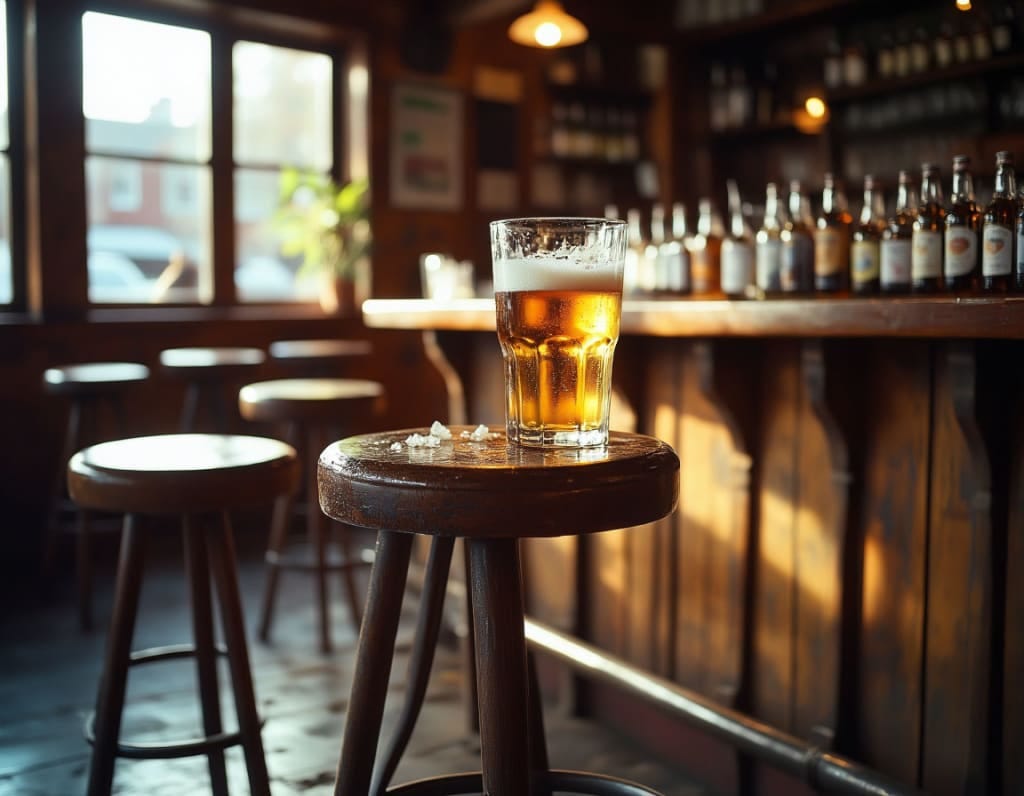
My first drink was a cold can of Ballantine’s ale, its sides dripping with condensation. “Good job,” my father said, nodding toward the neat lines of our freshly mowed lawn. Between the heat and my perspiration, I felt a buzz after the bite of the first swig. “You can have as much to drink as you want, as long as you do it here,” he said, recognizing the possibility of teen experimentation. I wasn’t a partygoer in high school, so I mostly complied with that rule, except for one afternoon at a friend’s house, where I tried shots of whiskey with beer chasers: “boilermakers.” I don’t remember riding my bike home or getting questions from my parents. But I must have reeked of alcohol.
College
Putting aside one incident for a moment, my experience with alcohol in college was probably typical. During the weeks when we couldn’t study anymore, a group of us would gather in one of the larger dorm rooms and drink rum and Cokes or Seagram’s 7 with Seven Up. We never got rowdy. The moment felt more like a collective sigh, releasing the pressures of sitting through one more lecture, writing one more paper, or studying for one more exam. We talked about politics, avoiding service in Vietnam, and the young women we wanted to date but weren’t.
On Friday nights, some of my dorm floor mates and I did our own version of a pub crawl through various college town bars. We were never carded. We thought it was because we ordered pitchers of beer with the deepest, most mature voices possible. While I had my fair share of the golden liquid, I was always up at 8 am on Saturday, sweating out the previous night’s consumption on the racquetball court.
The “incident” involved drinking a few beers at my brother’s off-campus house, followed by some tokes of his, “This is really good shit, man.” I passed out under his gurgling aquarium, which was the size of a steamer trunk, and next to a speaker blaring Iron Butterfly’s “In-A-Gadda-Da-Vida.” My roommate, Steve, eventually rousted me, and we began the long walk back to our dorm.
Along the way, we thought it would be manly to leapfrog over the twin-headed parking meters that ran the full length of the sidewalk in front of the university’s Art and Architecture building. I don’t know how many meters we successfully cleared, but on the last one, neither of us saw the large metal “No Parking” sign where we had anticipated the second parking meter head would be.
All I remember from that point on was another passenger in the dorm elevator pointing to the growing pool of blood on the floor and saying, “Hey, man, you’re really bleeding,” then lying in the well of the backseat of a car, mesmerized by the steady shift from light to dark to light as we passed beneath street lamps.
I woke up the next morning on my stomach in a heavily starched, white-sheeted bed, with a woman dressed in white leaning over me asking, “How you doin’, hon?” I won’t go into the details of my injury, only to say that a doctor told me I could still try to have children if I want them. “But it was close.”
I had to sit on a cushion during my classes after spending more than a week in the hospital and another week recovering at home. My parents didn’t launch into a “What were you thinking?” tirade. I guess they figured I was already working myself over with a virtual 2x4. Which I was.
Work
During my time as a high school teacher, alcohol consumption centered around what my fellow teachers and I called “hump day” — Wednesday. Hump day signified that we’d made it through the midpoint of a demanding week of teaching in a school environment that could be quite stressful. The student body was a diverse mix of Black, Latinx, and Eastern European whites who didn’t always see eye to eye, especially in the hallways.
“Hump day” saw us gather at a local bar, where the drink of choice was a vodka gimlet. “Hump day” was so successful that we eventually extended it to Mondays and Fridays.
I eventually moved from one stressful environment to another when I took a job as an editor for a large school textbook publisher. Developing a program under a strict deadline often meant working late into the evenings and on weekends. Johnny Walker Red, a blended Scotch whiskey, became a constant presence in my house alongside my take-home work and first wife. My tastes eventually shifted to single malt whiskeys, which, while more expensive than their blended counterparts, did nothing to reduce my consumption.
Today
As I settled into retirement, I enjoyed a recurring pattern of beers or gin martinis in the summer and scotch in the winter. I frequently augmented both practices on weekends with one or more glasses of wine.
During the early days of COVID, my wife and I decided to enjoy ourselves while being hermetically sealed in our New York City co-op apartment, listening to the constant whine of ambulances outside. So, we started our own “happy hour” with a glass of wine, cheese, and crackers. The glass sometimes turned into a bottle during a tradition that lasted until recently.
Growing up, my role models for drinking were quite restrained. My parents would sip a one-ounce shot of J&B Scotch between my dad’s arrival home and dinner. I don’t remember them ever having a second.
I didn’t have exhausting relatives at Thanksgiving rambling on about corruption, politicians, or welfare, punctuating their points with a sloshing glass of something.
At backyard barbecues, my dad’s family asked for “highballs,” a single shot of whisky mixed with Seven-Up or ginger ale. One drink was usually enough to have them singing Broadway show tunes long into the evening.
Now, after an eight-week break from my long-term relationship with alcohol, I’ve started to ask myself questions.
Does not drinking now mean I’ll never drink again?
When my wife and I travel to Italy this fall, can I have a glass of wine with my evening meal? (After all, it’s Italy…)
When it gets really hot this summer, can I have a martini?
How should I respond when completing the intake questionnaire before my annual physical asks, “Do you drink? How often?”
How will I answer friends I’m out to dinner with if they note that I’m not having my usual glass of wine?
Can I have an occasional drink without reverting to my old patterns of consumption?
And perhaps most serious, am I dependent on alcohol?
When my older sister first mentioned going to AA meetings, I thought she was joking because I’d never considered her to be a heavy drinker. I assumed it was a phase, in this case, trying a new way to fight the demons that had haunted her since adolescence.
But I nodded supportively, maybe to sidestep the ultimate question author Ruby Warrington asks in Sober Curious.
“Does the fact I’m asking all these questions make me…an alcoholic? Maybe.”
And if so, what hole is my drinking trying to fill? What is that “something else, something bigger” I’m fighting?
I believe that the Universe sends us signs, some of which we undoubtedly miss for different reasons. But if a sign grabs our attention, even for a moment, we face the choice of ignoring it or figuring out how to act on it.
My bronchial infection and the eight weeks of sobriety that have followed were clearly a sign, or I wouldn’t be asking myself all these questions.
So... what’s next?
One day at a time.
Steve Jobs famously said, “You can’t connect the dots looking forward; you can only connect them looking backward.” My guest in Episode 246 would respectfully disagree. In his mega-bestselling book, The Serendipity Mindset: The Art and Science of Creating Good Luck, Dr. Christian Busch writes,
“Serendipity is not just about a coincidence that happens to us, but it is actually through the process of spotting and connecting the dots that we start to see bridges where others see gaps. Serendipity is unexpected good luck resulting from unplanned moments in which proactive decisions lead to positive outcomes.”
I’m referencing this episode because my decision to at least pause my lifelong pattern of drinking is an example of serendipity—making a proactive decision after facing an unplanned moment. That critical pause gives me time to think and weigh a longer-term decision that I hope will lead to positive outcomes.
When my breathing became extremely labored in the middle of the night, my wife put us in a cab and off to the emergency room we went. We walked into a darkened, empty waiting room only to be told by the night clerk that the doctors won’t arrive until about 7 am. An “emergency” room with hours? Maybe it was that particular hospital, but we couldn’t help wonder what victims of a car accident, a shooting, or a physical attack would do?
The good news is, I was seen by a doctor, x-rayed—”Sì, hai la polmonite.”—and quickly hooked up to a miracle IV antibiotic, which I swear had me feeling 100% better in about 30 minutes. My care was free courtesy of Italy’s socialized medicine and the good people of Rome.
It's difficult to tease out the myriad reasons we drink alcohol in this culture. If it's possible to find a common denominator, however, it's this: We seem to need a balm to suppress something we'd rather not look at. I'm channeling Mickey Singer here: “You don’t have problems in life. You have problems with your thoughts about life.” It appears that alcohol becomes a tool for avoidance of those issues we'd rather avoid. Plus, social pressure is increasingly heavy to drink. Singer also hammers on one theme, that we're meant to be ecstatic, born that way, and constantly driven to return to that state. But we insist on dropping into 'human' mode, and dismissing the bliss we're entitled to. Thanks, Jeff, always open and courageous my friend.
It is remarkable how a heavy lung infection—something that literally steals your breath—ended up giving you the space to finally exhale, Jeff. You've spent a lifetime looking at the rearview mirror, but this pause feels less like a medical detour and more like a gentle invitation from the universe to examine that "something bigger" Callahan mentioned. There is a quiet, sturdy beauty in realizing you can stand taller than the habits that once defined your landscape. Watching those scenes of your past play out isn't just nostalgia; it’s the high-resolution data you need to decide which version of your humanity you want to bring to the table in Italy this fall. Ps. Ali and I will be in Italy (Venice, Florence, Brindisi & Verona) in April :-)