
Wolves, Men, and Mindsets
Cruelty isn’t just an act; it’s a state of mind

When I was around 11 or 12, my neighborhood friends and I used to explore the overgrown vacant lot at the end of our street, looking for insects to torment and kill. One of our favorite tools was a Ball canning jar with a wad of alcohol- or gasoline-soaked cotton balls at the bottom. We’d hold the jar under a spider and trap it by lowering the lid over it. We watched happily as the spider writhed in pain and eventually died.
We did these things and other acts because testosterone was starting to flow through our veins, like a trickle of rainwater moving down a dried desert creek bed after a summer thunderstorm. We were curious and instinctively wanted to test our environment. We were not yet aware that those spiders, small and confined to their self-made webs, were not mere objects for our amusement, but led lives that were key to the fabric of their local ecosystem. At that early age, “man over nature,” hard-wired as it was in our DNA, lacked an emotional counter such as empathy.
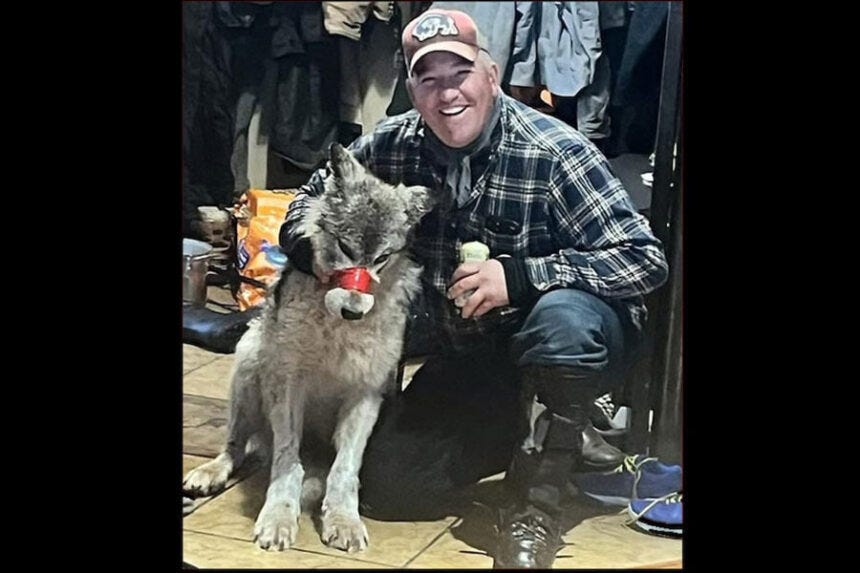
As I got older, I learned to temper those basic instincts and the behaviors they caused. Most kids do, but not all, I thought, as I looked at the picture of Cody Roberts holding a beer can in one hand while propping up the severely wounded wolf he had deliberately run over with his snowmobile in late February 2024.
While wolves are protected in much of the West under the 1973 Endangered Species Act, they lack federal protection in Idaho, Montana, and Wyoming. It’s legal in most parts of Wyoming, for example, where Cody Roberts lives, to kill a wolf “in any manner,” because they are classified as predators under state law.
According to eyewitnesses and video evidence, Roberts did not immediately kill the wolf after running it over with his snowmobile. Instead, he taped the wolf’s muzzle shut, abused the animal at home, and then brought the seriously wounded animal into a bar, where patrons could touch it and be photographed with it. Roberts eventually took the wolf out behind the bar, shot, and killed it.
In August 2025, a year and a half after the incident, a Wyoming prosecuting attorney secured a grand jury indictment of felony animal cruelty against Roberts. Roberts’ attorney contested the grand jury’s findings, not that the incident didn’t happen, but that it was legal under Wyoming law.
A county district court judge heard arguments for and against the indictment in a preliminary hearing in late January 2026. While the judge made no immediate ruling, he appeared to lean toward the prosecution’s case, noting that fully exempting predators from cruelty laws “seems a bridge too far.”
If the judge rules that the case can proceed, Roberts might go to trial in March. If convicted, he could face two years in prison and a $5,000 fine. So far, he has only been required to pay a $250 fine imposed by the Wyoming Fish and Game Department for illegally possessing a warm-blooded wild animal. In other words, he should have immediately killed the wolf after hitting it with his snowmobile.
Wolves and humans have a complicated history. Many Indigenous people have revered them as spiritual symbols, while others portray them as pure evil. “What wolves do excites men and precipitates strong emotions, author Barry Holstun Lopez wrote in his influential book, Of Wolves and Men, “especially if men feel their lives or the lives of their domestic animals are threatened.” Domestic animals include dogs, cats, and most importantly, livestock.
And therein lies the real rub when it comes to hating wolves. Cattle ranchers and livestock owners represent a significant voting bloc and are supported by powerful lobbying forces at the state and national levels. It’s why Wyoming has a law that classifies wolves as a “predator” and legalizes their killing “in any manner,” including running them over with a snowmobile.
Livestock losses to wolves can be devastating for individual ranchers, but the overall impact wolves have on the industry as a whole is minimal. That said, I don’t breed cattle for a living. My livelihood isn’t dependent on their safety, so I briefly try to put myself in the ranchers’ saddle if they find a carcass.
Wyoming offers to compensate ranchers for losses if they can prove that a wolf and not some other factor caused the death of their livestock. Additional compensation funds were included in the “One Big Beautiful Bill” that Congress recently passed.
It’s challenging, though, to make sense of the compensation programs on the one hand, against the killing by any means that the law allows on the other. Why is killing necessary if compensation is readily available? One reason might be that compensation applications represent bureaucracy. The rancher has to prove the cause of death, and that can take time and potentially lead to expenses on top of their future payout. A snowmobile is immediate justice. It deals with the cause rather than the effects.
There may also be something else at work here.
The killing of wolves in certain parts of the West today echoes strong historical precedent. In the late 1800s and early 1900s, wolves were nearly wiped out from the lower 48 states, including those that hunted in the mountains, as Lopez notes, “and had never even seen sheep and cattle.” No one knows for sure how many wolves were killed. A million? Two million? This was a period of species cleansing, fueled by fear and hatred of an animal that is highly adaptable, organized, and clever. Wolves’ main source of food is ungulates—deer, elk, bison—if they’re present in large numbers, but wolves will also take slower-moving livestock if they’re not.
Cody Roberts’ cruelty has drawn national attention. I don’t know his background, nor do I understand why he chose to chase the wolf until it was exhausted, and only then run it over. It’s easy to speculate, however.
Jim Magagna, the longtime executive vice president and spokesperson of the Wyoming Stock Growers Association, tried to distance the organization from Cody’s behavior.
“This was an abusive action. None of us condones it. It should never have been done. It’s gotten a lot of media attention, but it’s not exemplary of how we manage wolves to deal with livestock issues or anything.”
It was the same Jim Magagna, though, who warned Wyoming lawmakers against restricting the use of snowmobiles to kill predators, arguing that running down wolves, coyotes, and other animals with machines “is an essential tool for livestock producers.”
If I were the attorney trying the case against Roberts, I’d save one question until the very end of my cross-examination or closing argument. I’d place my two hands on the rail in front of the 12 jurors, look at them one-by-one in the eye, and direct my last question to the defendant. “Mr. Roberts, what did you do with the wolf after you killed it behind the bar? Did you just leave it there? Drag it into a field? Throw it in the bar’s dumpster?” I’d then turn and look, along with the jurors, at Cody Roberts.
Good theatre, but Roberts’ behavior and his state-fed underlying mindset aren’t the only things that should be on trial these days. Cody Roberts’ behavior reflects much of the physical swagger and verbal bravado we see, hear, and read about in today’s news regarding “immigration enforcement.”
Long-gun-wielding masked ICE agents round up immigrant citizens and non-citizens in any manner, while high-ranking government officials, including the President and Vice President, defend them. Simultaneously, right-wing influencers fan the flames.
Their collective lack of empathy, displays of masculine dominance, loss of control, and sheer callousness signal warning signs for what might come. The 4th, 5th, 10th, and 14th Amendments have become just words on parchment. It’s wolves and livestock all over again, where prairies have given way to cities. Immigrants are cast in the role of the undesirable wolves. Government officials and their masked minions play the role of the vindictive ranchers. Immigrants are dangerous and must be removed.
“Children often experiment with power before they understand consequences,” my colleague, neuroscience researcher Dr. Melissa Hughes, explains. “Most individuals grow out of it as empathy, the brain’s moral gatekeeper, develops in adolescence, and we are able to see other living beings not as objects but as lives equal to our own.”
My friends and I eventually stopped capturing and torturing spiders.
“But when that gate closes through ideology, power, fear, or emotional numbing,” she continues, “the brain does something extraordinarily dangerous: it normalizes cruelty. The suffering of another no longer interrupts thought.”
History is filled with the destruction that human cruelty leaves behind. Sometimes it’s carried out in the name of God, a dictator, or a flaccid slogan trying to evoke a period of greatness that never existed. It’s just a not-so-hidden desire for purity that’s as old as mankind itself. Among a lengthy list of just recent efforts was our own relocation of native Americans, “the final solution to the Jewish problem,” and the “Armenian genocide.” Today, it’s white “Christian Nationalism.”
What’s frightening is how quickly the right conditions can activate my human capacity for hatred and cruelty. I look at that picture of Cody Roberts, smiling while propping up the dying wolf, the object of his fear and hatred, and I briefly imagine myself on the snowmobile facing Roberts in a snowy field. He’s exhausted from running, perhaps bent over with his hands on his hips, trying to catch his breath. I see myself just sitting with the engine idling, studying this small man with no more options. When he finally looks up at me, I gun the engine and head straight for him.
And then I return to my typing.
Want to know more about wolves and men? For an in-depth discussion, listen to Adam Bronstein’s podcast Our Public Lands, Episode #62: “The Gray Wolf: Myths, Misconceptions & Culture w/ Amaroq Weiss & Samantha Miller.” Ms Weiss and Ms Miller are authorities on the gray wolf and the politics surrounding it.

One of my recurring focuses this year is writing. This week, I shared my discussion with Heather Lende, the author of four books, all centered around her and her small community of Haines, Alaska (pop ~2000). I’ve loved her writing ever since I read her first book, If You Lived Here, I’d Know Your Name, stories that grew out of the obituaries she writes for the regional paper. Her writing is plain yet eloquent, simple yet poetic. She’s teaching me a lot about the craft of writing, and my appreciation made her the perfect guest to acknowledge the show’s 400th episode. If you’re studying and practicing the craft, or if you need to write in any capacity in your daily work, you’ll want to listen to the discussion.
Next week, Hurley Winkler, a writer and teacher of writing, joins me at the microphone. She has that rare gift for making me feel like I’ve known her forever. What a fun and informative conversation. Her message about the craft of writing is powerful. Sitting down to compose a piece may feel like a lonely, solitary activity. It’s best, she advises, to build a community around you, not as an echo chamber, but as a support system—someone(s) who will support you emotionally and give you a critical eye and ear to help strengthen your writing. You can access our conversation here, starting on February 10th.
To that point, if you appreciated “Wolves, Men, and Mindsets,” I’d like to give a big nod of thanks to my writing coach, Cindy House. She sees things I would never see at this point in my development. Her instincts about what’s working and not working are scary good. I’m clicking away at the keys, but she’s always sitting next to me.
And thanks, too, to my dear friend, Melissa Hughes. I knew the piece needed some supporting commentary on the psychology and neuroscience underlying how mindsets are formed and adjusted—or not. I knew immediately who to turn to. Melissa makes neuroscience accessible to the rest of us and is a great example of a writing partner.
Growing up in Catholic schools, they always preached find the good in everyone. Sorry, there are some people like Cody Roberts, Steven Miller and many others you can name yourself that are cruel and evil to their core.
People who harm women, children, the weak, the sick, and animals lack human compassion. The abuse is their way of telling themselves they are powerful, when in effect they are weak cowards.
When one of these weak cowards is able to rise to a position of power, they validate cruelty and evil. The other weak cowards now step out of the shadows. Sound familiar?
We have been asleep at the wheel for too long. We must call out evil and cruelty. We must stay engaged, involved and resist. We must stop looking at voting as an option. We must identify people who more interested in the common good than lining their pockets.
This essay is both terrifying and relevant to me. My husband and I were just discussing the rise of female legislators and governors, and why it seems that they offer balanced strength when balance has never really been a quality resident in Congress. These females (Slotkin, Spanberger and several others) seem to be courageously speaking truth to power while the good old boys continue to speak in a language that makes sense only to followers. I don't mean to make this a gender issue, but as I read your description of growing up and experiencing the rush of testoterone, I couldn't help but wonder if the balance being brought by these courageous women and men that don't play the GOB game, will be what saves our country.