
Touching History (part 1)
There is no divining rod for finding our future.

Part 1
Our lives rarely follow the career paths we imagine as children; instead, they emerge from a mixture of circumstances, influencers, and serendipity. My youthful dream of becoming a pilot and an astronaut unraveled through an ill-advised interaction with a parking meter.
My fourteen-year-old grand-niece, Mary, recently announced that she wants to become an aerospace engineer. That’s a big shift from her previously expressed intended career: I want to be a cosmetologist. She’s coming to New York for a visit and wants to see anything related to space, so I’m going to take her to the Intrepid, a World War II-era aircraft carrier docked on the Hudson River that is now a floating museum of flight. On board is a prototype of the space shuttle Enterprise. “It’s big,” was my technical explanation.
Inevitably, when we were young, we were asked, “What do you want to be when you grow up?” I think a better question to ask young people would be, “What problem do you want to solve when you get older?” Think of the potential for a young Timmy or Julie, age 9 or 10, who responds, “I want to be an activist who finally convinces gullible people that trickle-down economics is a scam.”
I had no idea how to answer that question when Mr. Imig first posed it to me in the fifth grade. I had been looking out the classroom window, which I did a lot back then.
“Jeff! What do you want to be when you grow up?” Mr. Imig tapped on my desk. I could have responded with the standard “A fireman!” or “A forest ranger!” but instead I said, “I need to go to the bathroom.”
Like I did a few times during my elementary school days when I saw no purpose in an assignment, or didn’t have the faintest idea of an answer, I took the opportunity to visit the school’s janitor in his closet storage room. I remember he had a small transistor radio playing static more than anything else. I would sit with him for a few minutes, maybe ask about a tool or cleaner. And then he would walk me back to my classroom as he let me push the big floor mop.
Mary’s pronouncement got me thinking about how and why we end up doing what we do. My wife, Jennifer, didn’t wake up one morning and say, “I want to be a highly successful textbook salesperson in New York City,” which she became. She relocated from the corn and soybean fields of rural Maryland to New York City to prove to her skeptical mother that she could sing “New York, New York” and “My Way” just like Frank Sinatra, only with books instead of a microphone.
David Sedaris didn’t wake up one morning and say, “I want to write humor that catches people so off guard that it makes them spray their coffee all over the kitchen table.”
And I’ll bet our current President didn’t tell his 5th grade teacher, “I want to become the most corrupt, lying, self-aggrandizing public official in world history.”
“I want to be a pilot and an astronaut,” I realized after watching the Mercury, Gemini, and Apollo space missions of the 1960’s. True, I’m claustrophobic and highly susceptible to motion sickness—no back seats in a car for me—but I was enamored by the white-silk-scarf-around-my-neck romance of space travel, the physics that I still can’t explain, and beating the Soviet Union to the Moon. Take that Brezhnev! I went so far as to enlist in Air Force R.O.T.C. in college.
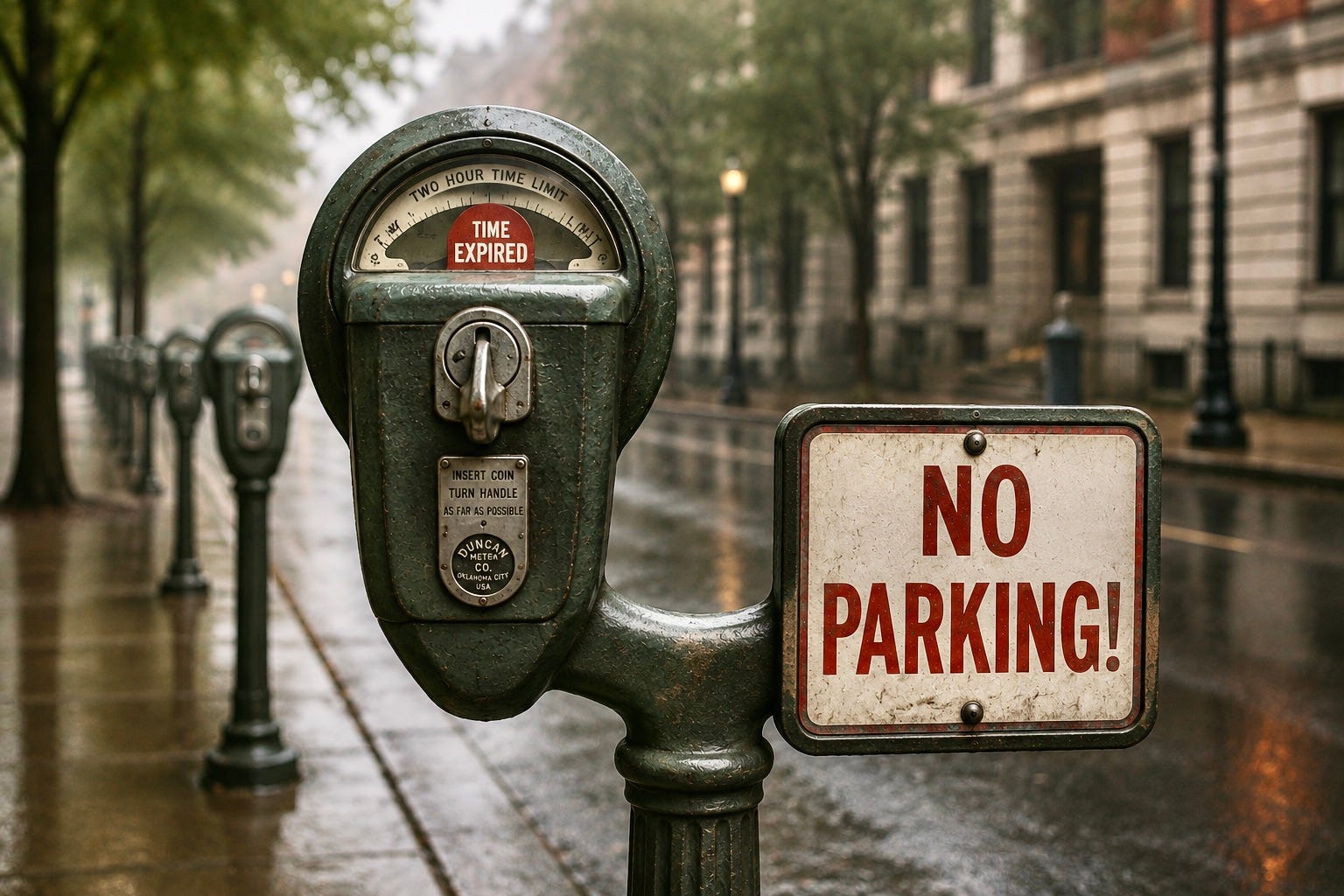
I’m convinced we end up doing what we do through an amalgam of circumstances, influencers, and serendipity. For me, one potential life path ended, and another began with a "NO PARKING!" sign.
Late one Saturday night during my freshman year at the University of Illinois, my roommate Steve and I partied at my older brother’s off-campus apartment. I had passed out under the softly bubbling fish tank, my head next to a stereo speaker, the new Rolling Stones album, “Let It Bleed,” blaring in my ear. Talk about foreshadowing. Steve eventually kicked me awake with “Ike, home.”
Still drunk and high, we headed to our dorm and decided it would be a good idea to leapfrog over a long line of double-headed parking meters in front of the University of Illinois’ Art and Architecture building. Blurry-eyed, I couldn’t see that the last one didn’t have two meters but rather a single meter and a large metal NO PARKING sign. If I had seen the sign, I probably wouldn’t have tried the jump, and my life wouldn’t have taken the dramatic turn it did. There’s no telling what would have happened to my life plan if it had been Steve’s turn to jump the last meter, with its slightly hidden sign. But it was my turn, and so, with my imaginary white scarf waving behind me, I launched myself.
The next thing I remember is riding up in the dorm elevator when some guy said to me, “Hey, buddy, you’re really bleeding.” Steve drunkenly explained that I had leapfrogged a parking meter as if it were an Olympic event. Uncomfortable laughter. I looked down at the elevator floor, and sure enough, I was bleeding, standing in a very red, ever-widening pool of “bleeding.”
I woke the next morning on my stomach in a hospital bed. I tried to shift positions, and the plastic liner, which I later learned was there to keep any residual drainage from soaking through to the mattress, crinkled loudly. Both it and the pounding in my head said, Yes, you’re hungover. Momentarily confused about why I was there, I heard a voice say, “Oh, no, you don’t.” The face belonging to the voice appeared at the head of the bed. “You’ve got to stay on your stomach for a few days,” a woman in white ordered. ‘Your bum is in no shape for….”
A movie-like trailer began playing in my head, filled with quick snippets of me drinking, Mick Jagger, Steve and me stumbling home, a series of parking meters, the elevator, me bleeding, and me lying in a fetal position in the footwell of a car’s backseat. “Don’t worry about the blood,” someone said. “It will be easy to clean up.” Then came the tiniest suspicion that I might have done something stupid.
Catch the conclusion next week.
This summer I’ve been releasing a series of mini-episodes where, in under 10 minutes, I examine a key concept from a previously broadcast episode. All the concepts in the series have lasting value, so I’ve named the series “Evergreen Ideas.” One of my favorite concepts is “serendipity,” which I showcase in Episode 426: Serendipity: The Art and Science of Creating Smart Luck.
Serendipity isn’t luck or coincidence; it’s about being curious and aware enough of what’s going on around you to spot and connect events and people to create—sometimes courageously—smart luck. I see evidence of a bit of serendipity in my early years.
Jeff, this is a wonderful, wonderfully honest piece. That shift from asking kids what they want to be to what problem they want to solve is a profound lens—and Mary’s leap from cosmetology to aerospace engineering shows just how magical those unexpected sparks can be. It is so true that life rarely follows a straight, pre-scripted path; it’s an unpredictable tapestry woven from sheer serendipity, key influencers, and, as you so vividly proved, the occasional ill-fated collision with a parking meter sign. Looking forward to reading Part 2 to see how that sudden pivot unfolded.
Jeff, my itinerary was a bit different insofar as I absolutely, without question or pause knew what I wanted to be: a Catholic priest! There was no talking me out of it when I was 12. The dilemma came along when I was dismissed from the HS seminary at the height of the VN war, lost my years-long dream, and got drafted. Funny how things work their way out. Looking back, for a variety of reasons I would not have made a great priest, and likely would not have continued in that life, especially the celibate part of it! Can't wait to read episode two.