
“Ich bin ein Berliner!”
“I am a Berliner,” said President John F. Kennedy in 1963, providing symbolic support for Democracy over Communism. Not everyone is a "Berliner" today.

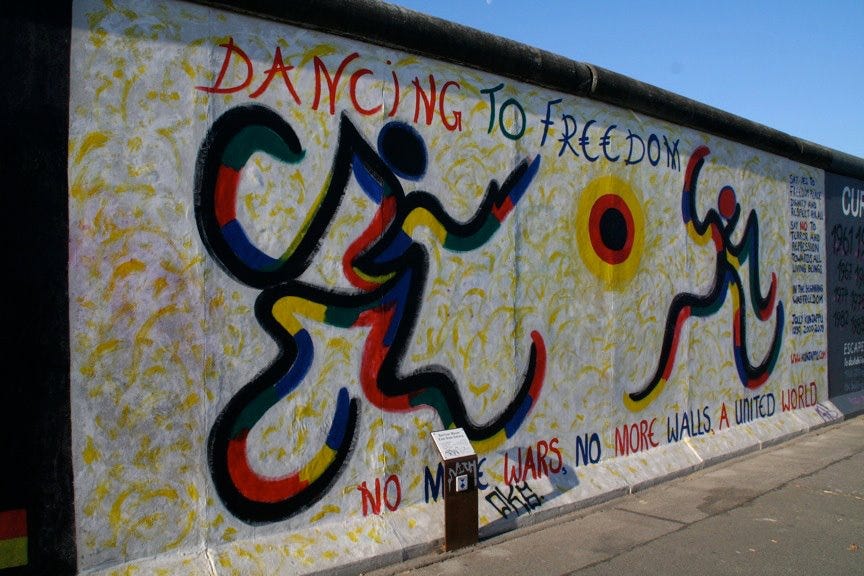
I am a creature of habit. After waking up around 5 am, I pour myself a cup of coffee in the mug I always use, check my email, and force myself to read three Substack articles that arrived overnight. Heather Cox Richardson, Joyce Vance, and Paul Krugman provide the historical, legal, and economic context on the latest unsettling news about the current administration.
As a result, I want to eat a gooey, icing-covered cinnamon roll, but instead, I’ll either walk in our neighborhood or our nearby forest preserve—hence, why I name my Substack site, “Walking in the Woods.” As the weather turns, I’ll skip the walk and jump on the stationary bike we purchased during the COVID-19 pandemic.
Our stationary bike features a large screen and a streaming service that allows us to ride in cities all around the world. I used to ride on the country roads through the Cotswolds, then switched to the forested grounds of an abbey in Ireland. Now I ride exclusively in Berlin.
The Berlin ride starts by taking me through the Brandenburg Gate, an 18th-century structure that has been a prominent landmark in Berlin’s history, especially since the 1930s. I see the original weathered columns feature lighter patches, giving them a mottled appearance.
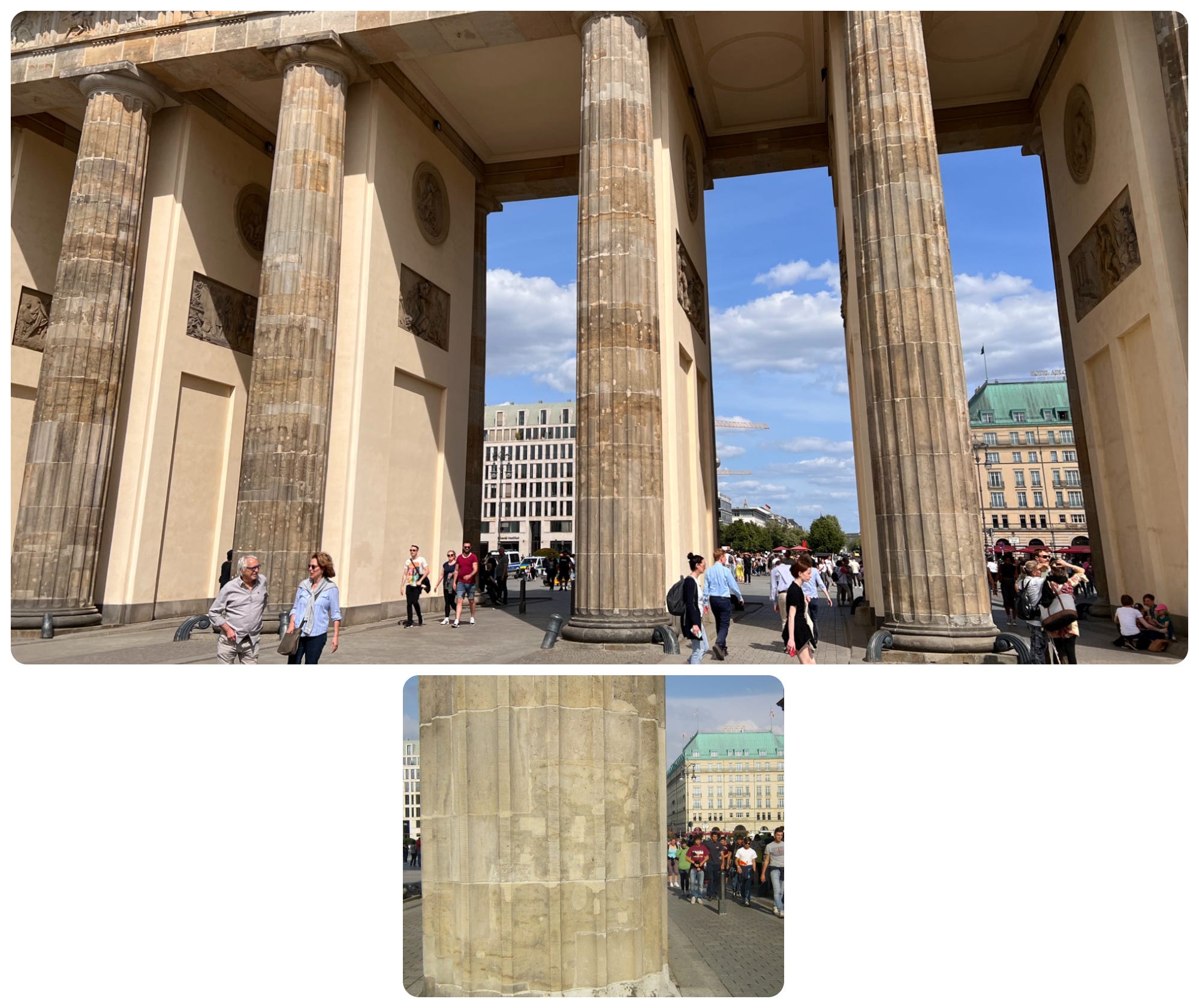
“Those lighter patches mark where the bullets and shells the Germans and Russians fired at one another inflicted damage during the intense battle for Berlin at the end of World War II,” a guide explained to me a few years ago. “The holes were patched with lighter colored filler so the damage from the war would stand out. It’s a visual history lesson.”
During the final years of World War II, as victory over Nazi Germany seemed imminent, the Allies—represented by Franklin D. Roosevelt, Winston Churchill, and Joseph Stalin—agreed to divide Germany into four occupation zones—American, British, Soviet, and later French—to prevent future military threats.
Berlin, located deep inside the Soviet zone, was also divided into four sectors. This setup was meant as a temporary way to manage postwar Germany, but it soon became a clear symbol of the Cold War between the United States and the Soviet Union.
My route takes me along a section of the Berlin Wall, a once-heavily guarded concrete barrier that encircled West Berlin from 1961 to 1989, separating it from East Berlin and the German Democratic Republic. Democracy existed on one side of the wall, Communism on the other.
As I ride, I can see three different treatments of the wall:
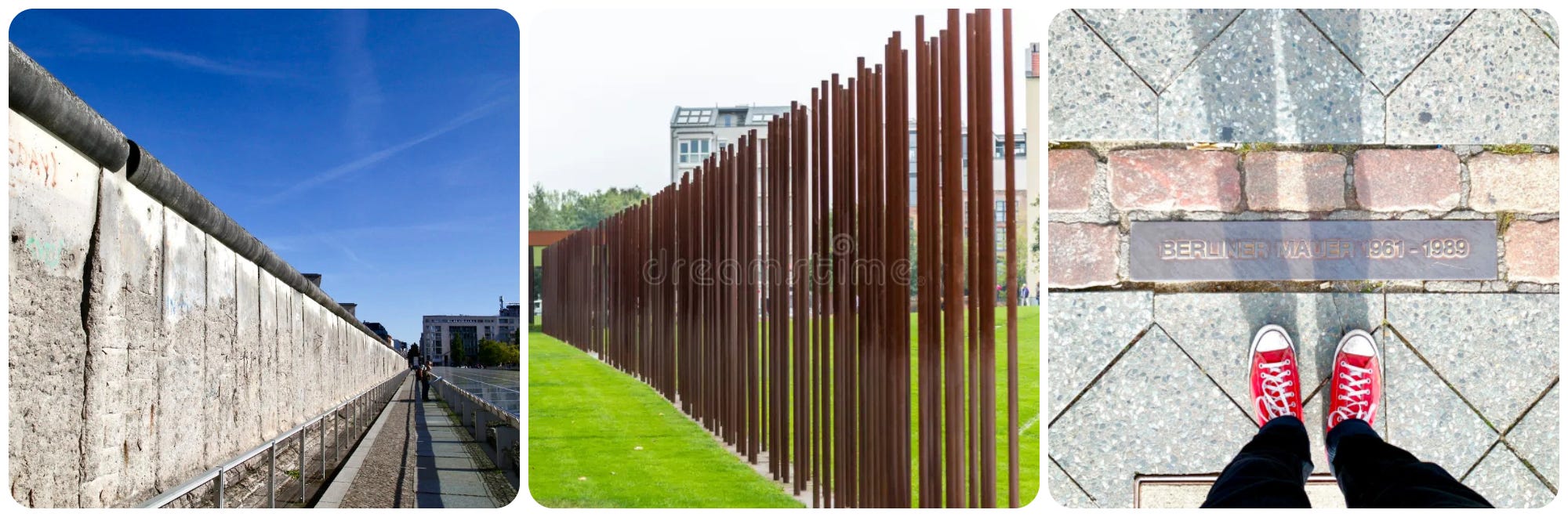
• Panels of the original concrete wall. Time, weather, and tourists’ hammers have left these panels, which stand 12-15 feet tall, battered, with their inner metal skeleton rusting in places.
• The Berlin Wall Memorial. The memorial features a row of steel rods where the wall once stood. This symbol of a divided Berlin allows visitors to look through the original wall, as it were, and see where democracy thrived on one side and communism ruled on the other.
• A brick pathway in the street. The path marks the location of the original wall, allowing people to freely cross the boundary between freedom and repression.
My ride turns onto a street bordering “The Memorial to the Murdered Jews of Europe.” The nearly 5-acre memorial features 2710 concrete blocks. The blocks are approximately 1 meter wide and 2.5 meters long, with heights that vary significantly. The shortest are flush with the ground, while the tallest reach nearly 5 meters in height. There are no symbols or writings above ground that say “Jewish.”
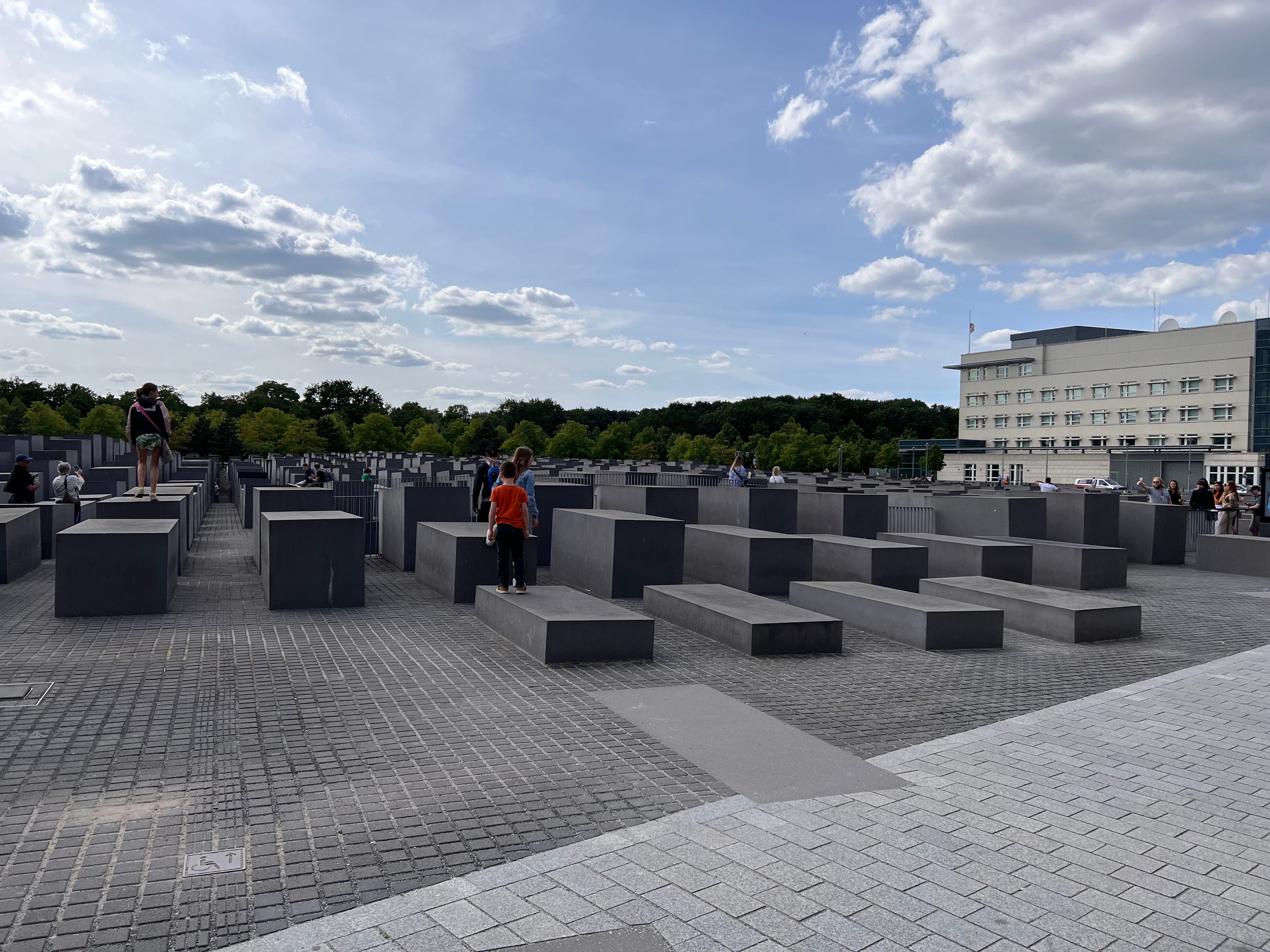
Because the blocks vary in height and the ground they sit on is uneven, the memorial appears to ripple like large waves. Some think the blocks represent gravestones, but that seems too obvious. Others see the uneven ground as a symbol of chaos and instability. That interpretation fits with the history of the Holocaust, but the artist was clear that the memorial should be what we choose to make of it.
Years ago, when I slowly walked among its undulating rows, I had the feeling of paralleling the history of the Holocaust. That dark period didn’t start with the killing fields in Eastern Europe or the gassing and cremation of trainloads of men, women, and children in the death camps. First came the restrictions, which started slowly, incrementally, along with small acts of violence. But then, more restrictions and violence followed in waves, each one stronger than the last:
You cannot worship among us.
You cannot work among us.
You cannot live among us.
You cannot live.
I eventually made my way to the memorial's center, dwarfed by the stones rising above me, which blocked out the light and my line of sight. The air was thick.
The experience is what we make of it. For me, the monument says that the Jews of Europe were murdered in an organized, purposeful campaign rolled out over time that was designed to disorient and confuse.
My ride begins to wind down along a path that follows the River Spree. Buildings along the river were bombed by the British at night and by the U.S. Army Air Force during the day. Most have since been replaced with modern, gleaming structures. Tourist boats quietly glide across the water beneath new bridges.
If you are a casual, uninformed tourist, you might think, What a lovely modern city. But in the distance, the reconstructed Reichstag, the former home of Germany’s parliament, rises above some buildings with its gleaming glass dome, and tells a different story.
Hitler secretly set it on fire early in 1933 and used it as a pretext to persuade Germany’s then-president to declare a state of emergency, suspending constitutional protections. The fire gave Hitler the final excuse to, in effect, tell the public, “See, the enemy is among us.”
Those six words remain just as relevant today as they did nearly a hundred years ago. Occasionally, unexploded bombs are found at the bottom of the Spree or at new construction sites. Sometimes, they go off on their own before demolition teams can disarm them. Each incident serves as a poignant reminder of a dark chapter in the city’s history.
And then there is President John F. Kennedy’s speech in June 1963. JFK used the phrase "Ich bin ein Berliner!"—I am a Berliner—to show solidarity with Berlin’s citizens, who lived as an enclave of democracy surrounded by communist East Germany.
Two thousand years ago, the proudest boast was civis Romanus sum ["I am a Roman citizen"]. Today, in the world of freedom, the proudest boast is "Ich bin ein Berliner!"... All free men, wherever they may live, are citizens of Berlin, and therefore, as a free man, I take pride in the words "Ich bin ein Berliner!"
Today, many of us feel like modern-day Berliners, surrounded by a new wall of lies, greed, graft, corruption, power grabs, real and manufactured hate, racism, bigotry, neo-fascism, Christian Nationalism, retribution through the weaponization of what is supposed to be neutral justice, scandals, censorship of the media, book-banning, anti-science, intimidation, sycophants, and opportunists. It remains to be seen whether we can bring that wall down.
I ride to remember.
Substack update: If you read last week’s essay, “Woof,” you’ll remember that I wrote at length about “Crackers.” He was recently adopted. With those eyes, I knew he would be. Someone or a family chose wisely.
Podcast update: If you’re a parent or concerned citizen about the eroding state of student engagement in K-12 public education, you’ll want to listen to Episode 381: “From Compliance to Curiosity – Rethinking Student Engagement.”
That's an arresting comparison, Jeff, between feeling like a modern-day Berliner, surrounded by a figurative wall of societal and political turbulence, and the historic weight of that city's past—it gives new dimension to Kennedy's defiant declaration, "Ich bin ein Berliner!" Your ritualistic ride through a digitized, scars-and-all Berlin is a powerful way to anchor yourself amidst unsettling current events, finding an undeniable truth in the physical reminders of past struggles, from the patched columns of the Brandenburg Gate to the undulating, wordless memorial to the murdered Jews of Europe; these historical touchstones highlight the perpetual human challenge of pushing back against rising tides of repression and deception to safeguard the universal aspiration for liberty and decency. Your commitment to witnessing these visual history lessons, even on a stationary bike, demonstrates a necessary vigilance in the face of the forces you cite, reminding us that every generation has a responsibility to humanity to tear down its own metaphorical walls of division.
Wow, I felt like I was along on the ride with you. Fascinating way to explore history (from a stationary bike!), though I know you were there in person, too. I'm always inspired by your curiosity and ability to synthesize complex concepts. And I'm so glad Crackers was adopted! :)