
Gestures
"What you do makes a difference. You have to decide what kind of difference you want to make." — Dr. Jane Goodall

I should first explain that I hated being a wrestler. I hated the smell of the gym – that mixture of rubber mats and sweat-soaked bodies that hung in the air like an ever-present cloud of victory or loss.
I hated the endless after-school training. Coach Walters’ whistle, followed by “Again!” like a record skipping because of an unseen scratch.
I hated the sleepless nights of worry, rehearsing moves in my head against imagined combatants. I hated that all that worrying gave me colitis.
I hated the peer pressure that nagged at me to play a sport. I didn’t necessarily want to be one of those jocks who swaggered down the hallways on Fridays wearing their letter jackets or sweaters, but I didn’t want to be on the outside looking in either. For much of high school, I was in that liminal space between being seen and mattering – as you think you can only matter in high school – and being no one in a graduating class of almost a thousand students.
I hated being out on the wrestling mat, me against one guy. It wasn’t that I was more at home in team sports. What I preferred was sitting alone at home reading about sports.
And I hated losing because, until the last match, it was never a fair fight. At the time, I weighed about 155 pounds. Our team had stellar contributors at 157 and 165, but lacked someone at 175, so I was assigned to fill that slot rather than have the team forfeit.
I didn’t lose by points, which would have lent some dignity to the six minutes of embarrassment. I lost by being pinned, usually in the first two-minute period, but certainly in the second. The ref would have been on his knees, his head flush with the mat, eyeing the distance between my shoulder blades and the mat as my opponent maneuvered his heaving breath, sweat, and extra twenty pounds onto my chest. I struggled to keep at least one shoulder off the mat. As the ref’s right arm and open hand were poised in anticipation of the inevitable, the attack and counter-attack moves I had rehearsed over and over in my mind during my sleepless nights were suddenly immaterial. Finally, when both of my shoulders were pinned to the mat for three seconds, the ref slapped the mat with a resounding WHOMP!
Then came the final match of the season. Once again, I was assigned to wrestle at 175, but this time my opponent was a kid who weighed about the same as I did and, like me, was forced to wrestle two classes above his weight.
A fairer fight.
Maybe it was the videos of continuous defeat raging through my mind. Maybe it was my dislike for the whole sport and my part in it that boiled to the surface. I may have won on points, or I may have pinned him in one glorious end-of-season exclamation point. I don’t remember anything except the ref raising my right arm and then being mobbed by my teammates when I came off the mat.
Coach Walters stood in our living room vestibule, rain dripping from his trench coat onto the small welcome mat. Sick with the flu and unable to attend the sports awards banquet, I stood at the top of the living room stairs, Kleenexes cascading from the pockets of my robe.
“Thank you, son,” he said, looking up at me, lofting the trophy into the air in front of him. My parents looked from him to me.
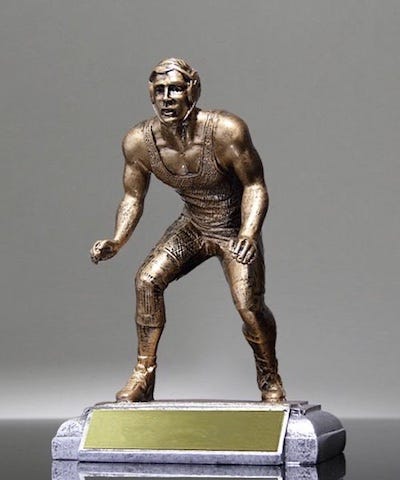
The trophy was perhaps six inches tall: a bronze grappler, knees and waist slightly bent, arms outstretched in front, poised to engage an unseen opponent. A small plaque read “Maine Township High School Wrestling, 1967.”
Despite going one and eleven, I never considered it a participation trophy. Someone else might have been embarrassed and stuffed it in the bottom of a drawer, or worse. To me, it meant everything, even if I couldn’t articulate why.
Although I would never wrestle again, the trophy stayed on my bookshelf throughout the rest of high school. I would eventually recognize it as a symbol of never giving up, despite the odds and the sport’s toll on my health. Most of all, it meant something because Coach Walters had hand-delivered it. The athletic department assistant could have just as easily sent a note at school telling me to pick it up from the wrestling office.
When I packed for college, I put keepsakes, including the trophy and my senior year high school yearbook, into a large box. I didn’t know what kind of space I’d have in the dorm room, so it was best not to overpack. I slid the large box into the attic with the intent of retrieving it one day.
That day never came. When I crawled into the attic after graduating from college, the box was gone. My father, the only family member who would have bothered with the attic’s contents, shrugged his shoulders.
One of the missing items was the stanzas from A.E. Housman’s collection of poems, “A Shropshire Lad.” I had hastily scribbled them while mesmerized by the voiceover that punctuates the melancholy ending of the movie Walkabout.
Into my heart an air that kills
From yon far country blows:
What are those blue remembered hills,
What spires, what farms are those?
That is the land of lost content,
I see it shining plain,
The happy highways where I went
And cannot come again
How ironic that a poem about loss and longing would come to symbolize my missing box of treasures.
I don’t know why my dad disposed of the box. Was it because I had moved out to attend college and left the contents behind, so maybe, in his mind, the items weren’t important?
Was it more personal? Was he angry that I was leaving him? During my high school years, we developed a strong bond through the only way he could relate to a teenager. Not through sports or academics like a lot of dads. He never attended any of my wrestling matches, nor did he take any interest in my studies. But he became animated when I worked as a newspaper delivery boy and grocery clerk. He couldn’t ask enough questions to satisfy his curiosity. Having lived through the Great Depression and World War II, he understood work. Work made sense. Wrestling statues and other youthful memorabilia? Not so much.
It was a gap my dad and I would never close, but eventually it didn’t matter.
The older I got, the more I came to appreciate my dad for what he could give. He was the consummate family provider, a dependable product of an earlier time. He loved the only way he could. The incident with the missing box faded by comparison.
And the memory of that night, when Mr. Walters stood, rain-soaked, in our vestibule, stayed with me, even if the statue didn’t. I came to appreciate that an object can be powerful either as a fleeting moment or as a lasting relic on a shelf. Almost 60 years after my high school graduation, Mr. Walters is one of only two teachers I remember by name. Long after the shrill of his whistle and “Again!” faded, I remember that what matters in life is more than a win/loss record.
The clarity that has come to me over the years is something many of us strive for yet often struggle to find. My guest this week in Episode #412, “From Insight to Action: How Real Change Actually Happens,” is Ashley Jablow. Ashley is a workshop facilitator, speaker, coach, and design strategist who blends design thinking and innovation, emotional intelligence, and creative tools to spark clarity and action for teams and individuals navigating change.
Wonderful and touching, Jeff. So evocative! I can see you on the mat, at the top of the stairs. And the reflections on the trophy and your dad are heart-piercing. Love this!
Such a relatable story Jeff. In high school so many us are like the round peg trying to fit into the square hole. It is exhausting, frustrating and in the end it doesn't work.
My parents also survived the depression. My Dad did whatever it took to provide. I never heard him complain. He just said we have to do what we have to do. He worked nights (4 to 11) until I was in high school, so he missed my early sport adventures. Once he was off nights, he was a fixture at every one of mine and my siblings games and events.
I finally realized when he didn't come to my events, he was doing what he had to do.