

Read the “Program note” at the end for the true story behind this essay.
I had heard the digging off in the distance at various times over the years, decades ago, really. Barely perceptible: the gentle scraping and brushing, and the clink of metal against metal from the archaeologists’ tools. We’re over here! We’re down here! I thought. But I gradually lost hope that I could be heard. I mean, I was just letters punched into a small piece of metal.
And you, of course, couldn’t speak at all with half your face blown away by the first German shell, and so much of the rest of you blown away by the second shell, including half of me. That’s the shell that buried us, the remaining half of me eventually resting inside the pulpy remnants of your face.
It always amazed me how quiet it grew when the trench collapsed over us. I felt the shells’ vibrations as they hit whatever they hit, but beneath a ton or more of dirt, compressed like we were a keepsake flower in a book, I could only hear the muffled boom of distant artillery and the occasional whistle of a shell flying overhead. And of course, there were the muted screams of the injured and the desperate cries for “Medic!”
It won’t do you any good to yell, I wanted to quip. You’ll bleed out before he arrives. But why dash hope?
And then, finally, there was just silence.
After a few years, I heard the chug, chug, chug of an engine and the deep, raspy cutting of the earth above us. Back and forth. First one way, then the other. A farmer tilling his field, perhaps? That’s what the land had been used for before the war. Not yet violated by the incessant pounding of remorseless ordnance and the rows of zigzagging trenches, one of which you fought from and died in.
And then, after almost 100 years, there it was right above us: that gentle scraping and brushing and the clink of metal against metal of the archeologists’ tools. My thoughts screamed, We’re down here! We’re down here! Then, furtive scraping and excited voices! And soon, the sunlight exploded off their metal tools as they pulled away the last of the compacted dirt.
All that remained of you, except me, was labeled and put into a storage box.
They turned me over and over in curiosity, rubbing off as much dirt as they could. They passed me around: a novelty, you see, because most dog tags in the war were made of a fibrous material and quickly disintegrated in the moist earth. But since you had been stationed in India before the Great War, you had been issued a metal dog tag — Me!— because standard-issue tags never survived that country’s heat and humidity.
I was dipped in a series of cleansing baths, and eventually a few key words and letters could be made out. We had served in the Lancashire Fusiliers. You had a name.
Your half a skull and a few bone and cloth fragments were eventually placed in a small, proper casket with me and transported on the back of a horse-drawn caisson to the cemetery, with a Union flag draped over us.
A small military band played “Nearer My God to Thee.”
Our casket was carried to the newly dug grave with its smart angles and straight walls. A solo bagpiper played “Flowers of the Forest.”
An officer from your unit read, “Today, more than a century after the guns of the Western Front fell silent, we welcome…” and your name was spoken publicly for the first time in decades. The officer didn’t describe your grisly end in a war that was a meat grinder for Europe’s youth. He didn’t say that there were thousands of remains that had yet to be discovered, still lying beneath farmers’ fields. Not the right time or place perhaps. Maybe that was for historians to say.
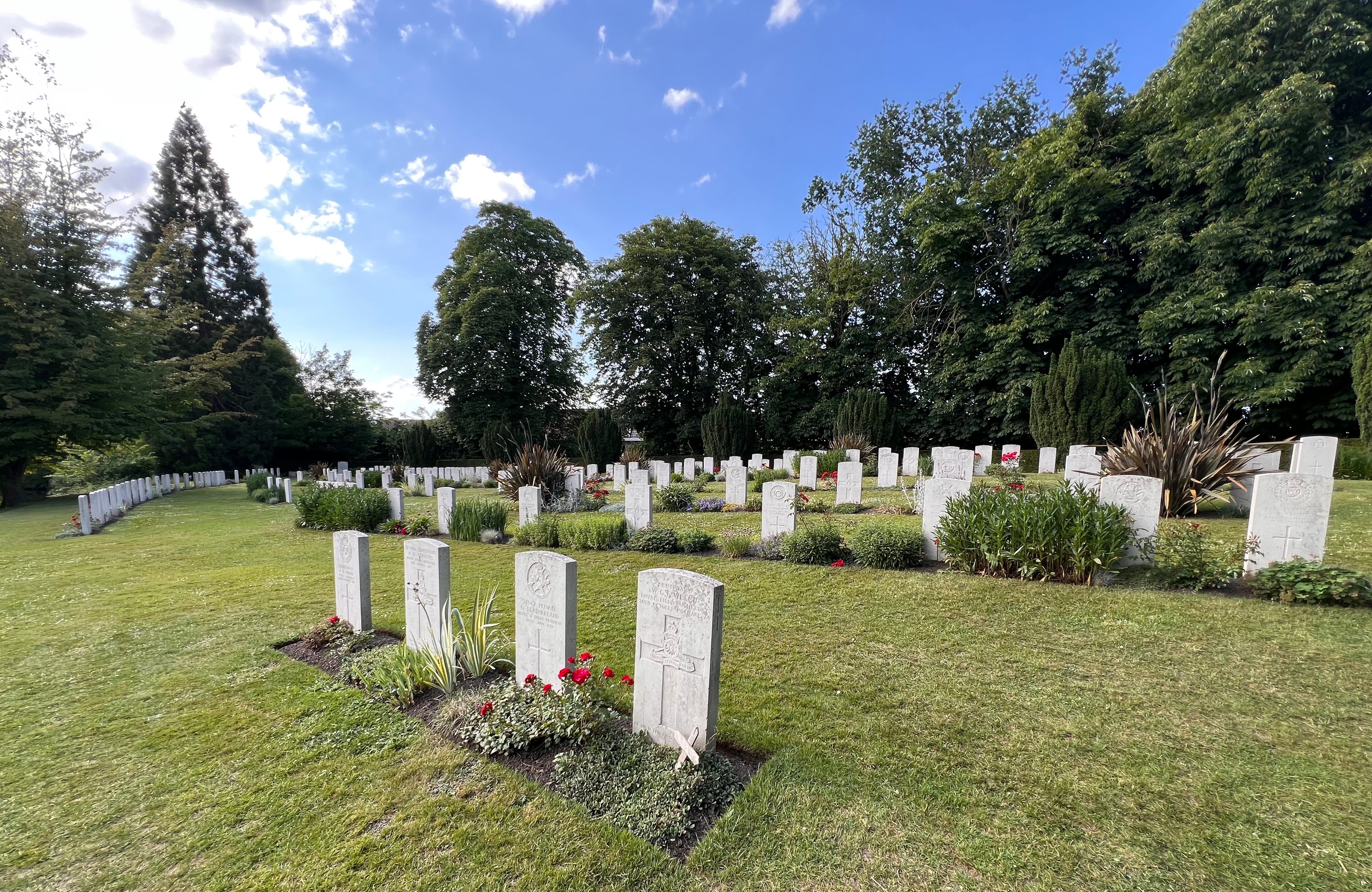
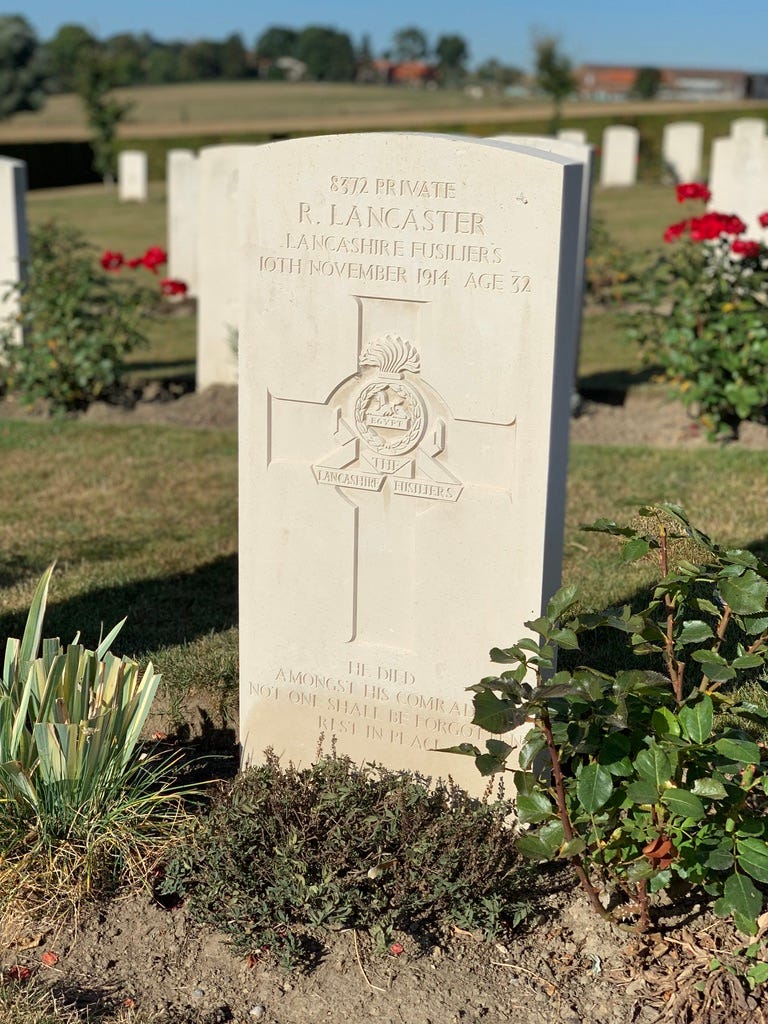
Finally, we were lowered into the ground once again, this time beneath a gleaming white headstone bearing your name, standing in a long line of white headstones amid rows and rows of white headstones. Alone no more.
A star was placed next to your name on the “Wall of the Missing” memorial, indicating to visitors that you had been found. That we had been found.
Every few years, I feel the gentle vibration of footsteps that stop above us. A visitor! Maybe they read the inscription:
HE DIED
AMONGST HIS COMRADES
NOT ONE SHALL BE FORGOTTEN
REST IN PEACE
Maybe their fingers trace the carved letters of your name and age, noting that you were only 32 when you were killed. Maybe they lament so much life not lived.
In one grave. In one row. In one cemetery. In one war.

This essay is also available on 7/21/2026 as an audio file in Episode 424.
Program note: The story behind the essay
For the last few years, my podcast has offered an eclectic array of episodes on topics that triggered my curiosity. My interest in the two World Wars is an example and has led me to various sites across Europe. I’m indebted to Iain McHenry, my guide on one tour, for sharing the story of the discovery in 2006 of the remains of Richard Lancaster, a private with the Lancashire Fusiliers. This essay was based on Iain’s detailed explanation. Richard was killed on November 10, 1914, during the First Battle of Ypres, Belgium. I interviewed Iain in Episode 308. It is one thing to read history; another to walk where it happened with an informed and passionate storyteller.
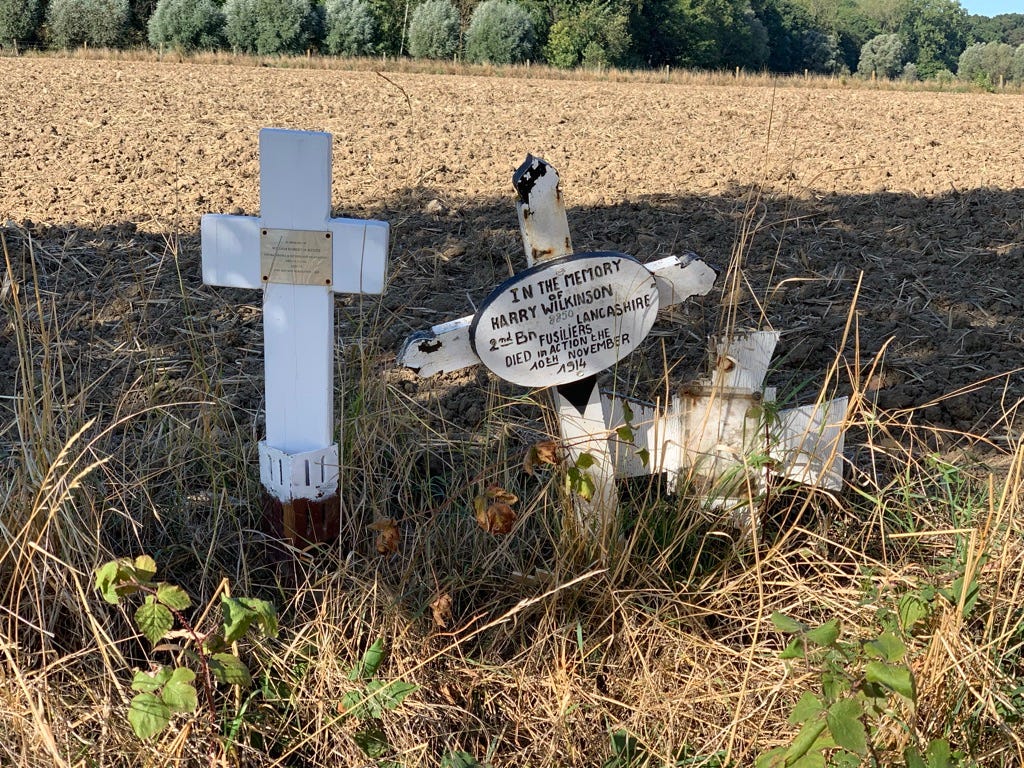
The remains of countless thousands of soldiers from many nations still lie in farmers’ fields, waiting to be discovered. Some soldiers were so vaporized by explosions that their remains will never be found.
I’m also indebted to Cindy House for her reading of this essay in Episode 424. Cindy is my writing coach, and our Friday meetings are a high point of my week. She epitomizes good teaching: she is quick to challenge me to “dig deeper for my real story,” offers sound suggestions, and then praises me when I hit a strong note. I can’t imagine taking this writer’s journey with anyone else.
This essay came out of a prompt Cindy suggested a few weeks ago: “Write about a headline that never left you.” I was mesmerized in September 2019 when Iain and I walked the ground where Richard was found. I’ve not been able to forget the story in part, I think, because there are so many other Richards who’ve never been found. The Menin Gate in the town of Ypres, Belgium, bears the names of more than 54,000 Commonwealth soldiers from World War I whose graves remain unknown. France and Germany have similar walls, remembering their missing.
Rather than tell the story as a straight historical narrative, I wanted the piece to have a distinct voice. That’s where I got the idea for the piece to speak from Richard’s unique dog tags. Cindy immediately raised her hand to be the reader.
«»
In June 2025, I again toured with Iain, this time focusing solely on the Battle of Verdun, which was fought from February 1916 to December 1916. It became the longest battle of World War I, resulting in more than 700,000 casualties and 300,000 deaths on both sides.
One stop was the Fleury-devant-Douaumont National Necropolis, the largest French cemetery from the war, with more than 16,000 graves. Attached to the cemetery is the Douaumont Ossuary, which contains the skeletal remains of more than 130,000 unidentified combatants from France and Germany. Portals along the ossuary’s wall allowed me to look inside at bones simply stacked in an almost unending pile.
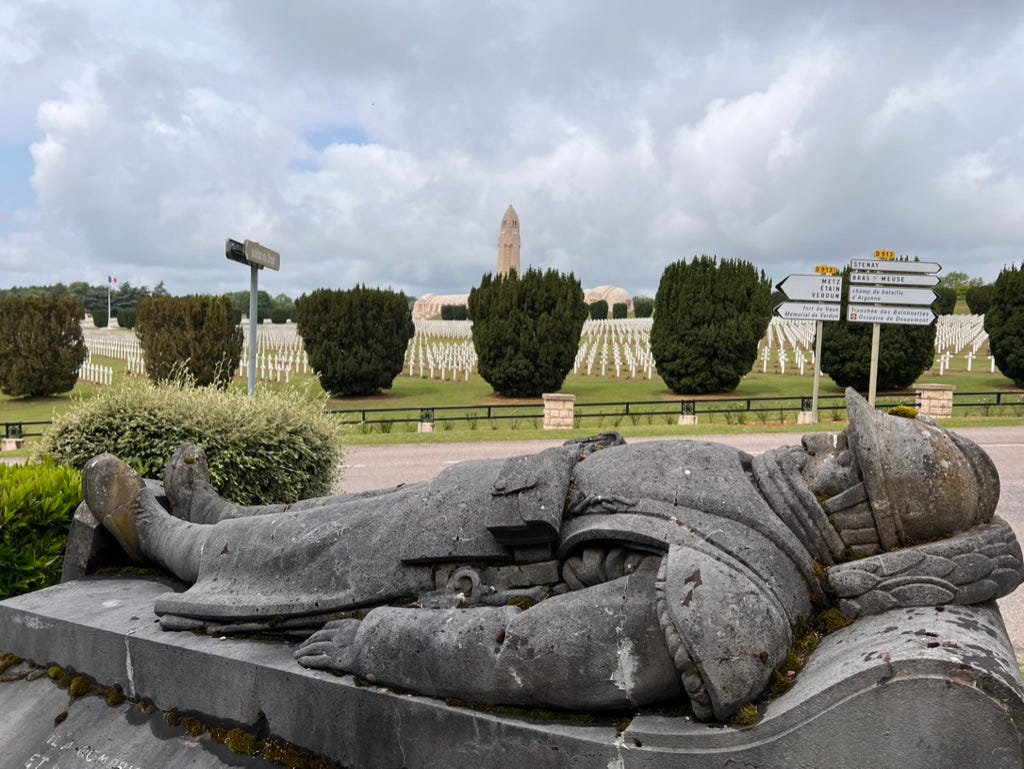
While these numbers are staggering, almost incomprehensible, they come from a single battle in a single war.
Those men who died during World War I and other wars and whose bodies or remains were found now lie in silence in beautifully manicured cemeteries all over the world. Green lawns and white headstones have wiped clean the horrors that once took place on the same soil. Those who grieve the soldiers’ deaths, whether relative or visitor, may be comforted by slogans such as “the cost of freedom.”
But as I look out over the graves, I am simply struck by how limited humans are in their ability and willingness to avoid the carnage in the first place.
Echoing our friend, Dennis's words about the genius of telling the story by way of a seemingly inanimate object that comes to life in our imaginations carrying the story even more poignantly than by a human narrator. We may have heard that particular voice too often for impact
Last night I was re-watching a wonderful PBS program, Mr. Selfridge. In Season 2 boys from the department store sign up to fight the Kaisier. Before they leave the store to register with the recruiter they march 2 by 2 in their aprons, loading dock coveralls, dining hall ties & black jackets & led by a single drummer before they stop to receive the farewells of their friends & staff.
You would have to have the heart of KegSeth not to shed tears then. Those boys - many of whom had never been outside of London - who wanted to see France - had no idea what they were walking into.
And that's the measure of war.
That's why we need your voice & the stories.
As if we didn't know the madness that any war entails. It made wonder how many dog tags are deeply buried, having their own conversations with 'remains' somewhere near Khe Sanh, or Chu Lai, or along the Ho Chi Minh trail? War truly is, as Bertrand Russel said, 'a collective insanity.' Thanks, Jeff, keep writing about it.