
Finding My Way
It’s not the steps we take that matter, but where we’re headed.

For the past few months, I’ve caught myself counting.
I’ve counted the steps from our co-op apartment to the small room on our floor where residents temporarily store items for recycling: 35 steps.
I’ve counted the steps to the elevator on our floor: 42 steps.
I’ve counted the steps in the stairway from our floor to the first floor: 72.
I’ve counted the steps from when I leave the subway to when I exit outside: 45 steps. That’s three flights of 15.
And I’ve found myself counting steps from our front door as I walk up the street or into our co-op’s courtyard. I stop counting when I realize I’m counting and chastise myself with Why are you counting!? It’s like I’m on autopilot. I leave my apartment and start counting steps.
I don’t count people ahead of me in line at the grocery store, or how many seconds it takes for the first driver to lay on their horn when the light at our corner turns green. I don’t count how many times Trump’s name appears on the first page of the electronic edition of the New York Times.
I just count my steps.
I initially thought it was just a mindless activity to do while walking, since I tend to think about odd things now and then, rolling them over in my mind like a sculptor working a ball of clay to make it pliable. The other night, I had to stop reading a book on fly fishing to look up whether trout sleep.
I’ve also wondered how nature figured out that fires should be a key part of its forest life cycle. The heat from forest fires actually helps certain pinecone species release their seeds. I remember that from my high school Biology class. Left alone, a forest knows how to regrow itself without the well-meaning actions of the National Forest Service. But how did it figure that out?
And one item that’s really got me wondering is a piece of advice I came across from the Austrian poet Rainer Maria Rilke on how to think differently in a time of uncertainty. Instead of rushing to clarify a situation, he suggests we try to “love the question” of the moment. Let things sit. “Live the questions now,” he advised.1 Hold the easy answer at bay to see what else emerges. That advice runs so counter to the ways our brains are programmed to work. They crave certainty.
It was initially discomforting just to sit with uncertainty. It was like the itchy feeling I had as a kid when I had to wear a wool suit to a Sabbath evening service. My mom would pat my leg as if to say, “I know, dear, just a little bit longer.” But, leaning on Rilke’s advice, I tried to love the question: Why do I count my steps? I was curious. Like rewinding a videotape, I played back moments when walking had impacted me to see what might emerge.
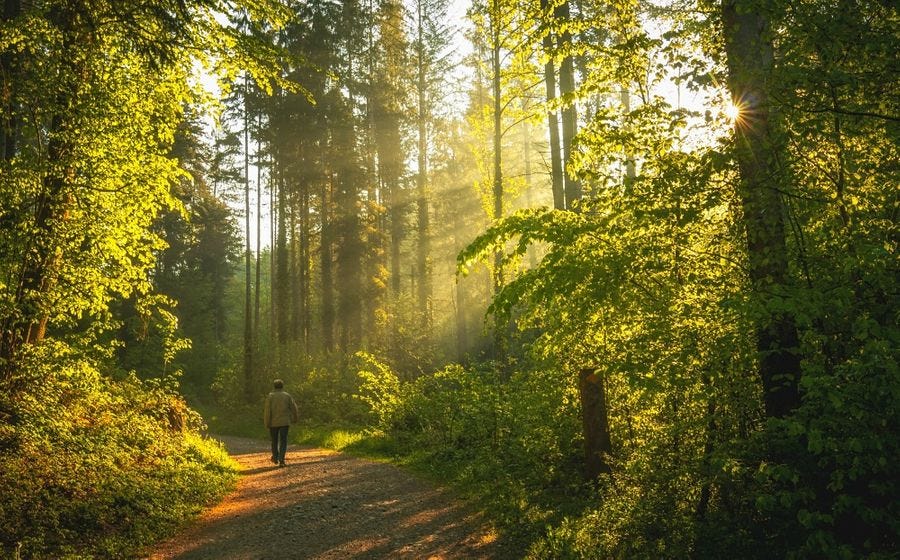
I love walking in our nearby forest preserve. I do some of my best thinking there. Maybe it’s like one of my podcast guests remarked about his own experiences in a forest, where he listens to what the trees are whispering in response to his quiet musings. But it’s been too cold or snowy, too gray and dreary really, to do much walking in the woods this winter.
I enjoy walking to our nearby grocery stores to pick up a few items I need for our evening meal. It makes me think about what life would be like if we lived in Rome or Paris — taking a daily stroll to the local market for fresh foods, so I wouldn’t have to worry about storing them in our apartment’s tiny fridge. Again, our winter has worked against my plans to play out my European fantasy.
And then I thought of my neighbor, Elliot, who struggles to walk. He has Parkinson’s, and his condition is clearly worsening. I’ve passed him several times on the sidewalk and asked if I could pick up or carry anything for him. His pride always forces him to gratefully refuse. He trudges on, his feet barely leaving the surface of the sidewalk as he shuffles along. It’s painful to watch.
I recently found him slumped in our hallway, unable to walk the mere 14 steps from the elevator to his apartment. His legs simply gave out. I called 911 and sat with him until the medics arrived. He’s never been much of a talker, and he must have been embarrassed and probably scared of what was happening. I promised to keep the few items he had picked up at the grocery store until he returned. He was hospitalized for a few days, and now he gets around with a walker, taking one careful step at a time.
I just had my annual physical, which included a treadmill stress test and an echocardiogram to check how my heart is functioning. The rhythmic opening and closing of valves with their characteristic “swish, swish, swish” was reassuring. “Everything seems fine for now,” my doctor concluded, but then she couldn’t resist adding, “You know, you are getting older.”
Mentally replaying these scenes made me wonder whether counting my steps is a subconscious way of reminding myself to be grateful: I can still walk.
Trout don’t sleep, by the way. Instead, they enter a state of reduced activity and metabolism while staying alert to life’s uncertainties posed by predators and potential changes in their environment, including the dangers posed by fly fishers like me.
While they have never read Rilke, trout seem to be masters of living with uncertainty rather than catastrophizing about possible negative consequences. They appear to live in the moment, embracing the question of how to find sufficient food and safety while expending the least energy, rather than constantly swimming about in a frenzied state.
Psychologists tell us that we humans usually behave in the opposite way. Our projections of possible negative outcomes to an unsettling event are significantly worse than knowing the outcome. That explains why, during the rollercoaster times we’re living in, many of us remain in an unending state of anxiety and worry.
Maybe counting steps through empty hallways and stairwells, alone and shielded from distracting family conversations, momentarily distanced from the shocking behavior and complicity of those in power, was merely a nervous tic—an obsession with something so trivial that it kept my uncertainty and my anger at its perpetrators at bay.
As I write this, it’s going to be 70° here in NYC this afternoon. A mating pair of doves has returned to our balcony after spending the winter in a warm place. All manner of bulbs will soon be peeking through our co-op’s gardens. Soon, our courtyard fountain will be a balm to those who sit near it. For me, it’s time for a walk in the woods, and as Rilke suggests, to just be with the questions of the day and not immediately grind away at seeking answers.
Who knows what advice the trees might offer?
For a deeper dive into living with uncertainty, listen to Episode #391, “What Can Chronic Uncertainty Teach Us About Control, Acceptance, and Resilience?” My guest, Jon Gluck, recounts the chronic uncertainty of living for more than two decades with multiple myeloma, an incurable but treatable bone-marrow cancer.
Author Elizabeth Weingarten quotes Rilke in her book, How to Fall in Love With Questions: A New Way to Thrive in Times of Uncertainty
You & your work often show up as the GPS in my life.
Echoing the comments here.
I love this one, Jeff. Slow down. Pay attention to the neighbor who may need you to do more than walk by consumed with the “busyness” of your to-do list. Allow nature to restore you in a way only nature can. Count the steps. Indeed the stress of the unknown is almost always worse than the known. The human brain is funny that way. I love the way yours thinks. Thank you for sharing this one, friend.