
Connecting
“And that led to this.”


While attending a conference in Austin, Texas, I snuck in a visit with Elizabeth Keating, a former podcast guest. Elizabeth is a retired professor of anthropology and the author of The Essential Questions: Interview Your Family to Uncover Stories and Bridge Generations. She has an honest, welcoming way about her. Though we had never talked without the microphone between us, connecting with her at breakfast was like talking with an old friend.
Her book contains hundreds of questions one can ask parents and grandparents to uncover their and the family’s past. Regrettably, my grandparents were unavailable to me either through death or distance. And I never knew the questions to ask my mom and dad before they passed to understand them as “Bette” and “Bill.” However, just reading the questions in Elizabeth’s book, which I’ve curiously placed on my bookshelf with the cover facing me, started to rustle the often leafless branches of my memory. Mine is often a deciduous past in the dead of winter.
What I’ve come to realize in my longing to truly know my parents and grandparents was a desire to connect with myself, to see the links between who they were and who I am. By extension, I wanted to hold my non-family connections up to the light. What did my current and lost connections say about me?
My focus on connections could be part of the natural aging assessment. I just turned 74, and lately, the rearview mirror has garnered much of my attention. It won’t surprise anyone close to me that I’ve been tinkering with a memoir for over a year. I may not know what’s under the soil at the moment, but I’m digging as rapidly as my lizard brain and Muse will allow.
“Context”—my insatiable need to know the why and how of the past—is my top Gallup Strengthfinder Skill. I’m convinced I studied history and became a history teacher to feed that DNA. (So much for initially majoring in math in college.)
Relatedly, anyone who has listened to my podcast knows I love the concept of serendipity—the idea that the universe routinely presents situations, ideas, and people we can choose to recognize and, more importantly, connect with.
And then, there is this:
In the late 1970s, I and millions of other viewers were mesmerized by a 10-part BBC series called Connections. Based on the book of the same name, the series featured British science historian James Burke. Burke examined science and inventions from different subjects and showed how new ideas and discoveries built on each other over long periods of time, eventually connecting to create the technology we benefit from today. He often punctuated a description of how seemingly disparate ideas led to something we know today with the expression, “And that led to this.”
My favorite episode saw Burke connect Napoleon’s critical need in the early 1800s to support his enormous army with sufficient food to the function of a key component of the massive Saturn V rocket, which helped put men on the moon beginning in the summer of 1969. If you’re thinking, "Wha???" you’re not alone. But I assure you, Burke did a masterful job of tracing how the trip to the moon was related to Napoleon’s march across Europe.
Just for fun, the Napoleon/Saturn V rocket connection story reads like this:
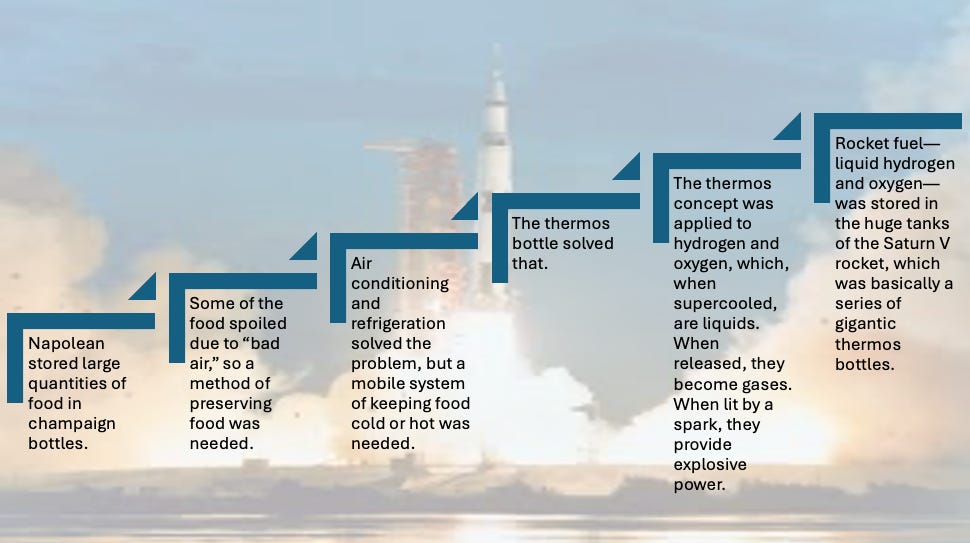
The Saturn V rocket was really a series of gigantic thermos bottles filled with supercooled liquid hydrogen and oxygen held under pressure. When that pressure was released, the liquids rapidly evaporated as gas. When forced through constricting nozzles and ignited, those gases released a cosmic amount of combustible energy—in Saturn’s case, 7 million pounds of explosive thrust. How else could you lift a rocket weighing over 6 million pounds off the launch pad? (See the short clip from the series at the end, where James Burke helps us visualize the story of the thermos concept applied to rocketry.)
My fascination with connections has become a critical focus of my weekly podcast. Ezra Klein, a New York Times Op-Ed writer, and Chris Hayes, a host at MSNBC, have recently argued that the proliferation of information courtesy of the internet has made our attention the most valuable currency in the world. As a result, my listeners inherently want to know how a topic directly affects their lives. If it doesn’t appear to, they will take their precious attention elsewhere.
It’s easy to explore topics that immediately connect to my listeners. Elizabeth’s book on asking questions to unlock our past is a case in point. However, given the eclectic nature of my show, the connection / application / relevance to my listeners of some topics might not be as immediately apparent.
In recent weeks, I’ve focused on the Home Front during World War II, building secure animal crossings above and below roadways, and trekking in Nepal. In the next few weeks, I’ll post episodes on a new method of cattle grazing and the origin of Native peoples in the Americas. These are fascinating and essential topics to understand us and the world today, but their lessons—their connections to my listeners—may not be immediately apparent in their titles.
And that’s when I get to access my best James Burke. I want to showcase that link—that metaphorical Click!—between this and that because that Click! helps me and, by extension, my listeners make sense of today’s agitator-like world.
And that’s when we all get to say, “Ah, and that led to this.”
Episode 351: Looking Differently at Cattle Grazing, Soil Health, and Climate Change, which will be published on Tuesday, February 25. It’s a strong example of where we can showcase powerful learning that might not be immediately apparent when discussing cattle grazing. (“Moo.”) But I promise you, it’s there. Click!
And again, you can access my wonderful conversation with Elizabeth Keating here. Click!
Finally, in the following clip, Science historian James Burke walks us through how the idea of the thermos was critically applied to rocketry in episode 9, “Countdown,” from the Connections series. It’s one of the most impressive bits of filming you’ll ever see. Click!
No matter how old we are when we lose parents or grandparents, or anyone else close, there are things that were left unasked or untold. We ask different questions at different times in our lives, and we hear the answers in different ways as the years pass and we gain more insight into what it takes to survive. “Context” changes from hour to hour, year to year, and I’m afraid there’s no catching up to it.
As a not-so-unbiased reader, I absolutely LOVE this piece. Why more than any others? I too, crave the connections with family who have answers to questions we are too late to ask. EVERYTHING is connected, and now, more than ever, we should all crave connecting, at a time when it is so easy to feel the opposite. Thanks for linking our past with our present and in turn, our future!