
A Unexpected Behavior
Unread books still matter.


A colleague of mine and I were recently discussing the shifting tectonic plates of foreign and domestic life, and at one point, she asked a provocative question: “Where do you find safety and comfort these days, perhaps in an unexpected way?”
My first thought was carrot cake. I’ve often joked with friends that if I knew government secrets and a nefarious group wanted me to tell all, carrot cake would be a sure-fire sodium pentathol substitute. “What do you want to know?” I’d ask between large bites of the moist cake and icing.
I cower under my desk was another thought. I’ve considered it, but I haven’t done it. All those electronic cords and dust.
The Beach Boys’ hit song “In My Room” came to mind because retreating to my room was a steady practice back in my middle school days.
But she was serious, so I reconsidered.
I do one thing, but I’m not sure how unexpected or unusual it would be, given the enormous popularity of YouTube, Instagram Reels, and TikTok, but here it is: I replay clips from three of my favorite movies: Flight of the Phoenix (the original version only, please), Sneakers, and Seabiscuit. Repeatedly.
Each of these clips features a major turning point in the overall story, a key object, music building to a crescendo at the precise moment of the turning point, one or more elements of impactful character, a memorable line, and a complete story arc: from desperate to hopeful; from not knowing to a frightening realization; and from failure to redemption.[1]
Together, the elements offer a masterclass in storytelling, something every writer, whether aspiring, as I am, or a veteran, is compelled to study. At some level, studying those story elements with the intent of someday mastering them represents “safety and comfort,” because why else would I watch them repeatedly? That said, they don’t quite fit the context in which my colleague posed her question. We were discussing the events and people that are rocking our domestic tranquility, not personal growth.
And then the Universe pointed.
I came across a New York Times book review of Angel Down, a Pulitzer Prize-nominated novel set during World War I. While I’ve been a student of the two World Wars for as long as I can remember, I typically don’t read much fiction (it’s a long story). But here, my curiosity was piqued when I read that this “thunderous gallop of a war novel” is written in a single sentence that ends with a comma rather than a period.
So, I bought it, and that’s when the answer presented itself, like a slap on the forehead.
I buy books all the time that I intend to read, but often don’t. I have titles I’ve mentally labeled “Will read next” and “Will really read next” books. Sometimes I actually read them, but most titles are pushed further down the queue when another title is added.
The unread titles don’t silently chastise me. There are no tsk-tsk admonitions from the shelves. My books are content to wait their turn or simply to fulfill the role I ask of them: guardians of potential for discovery, knowledge, and wisdom. They are my safety and comfort, unexpectedly so, because while some may be read, others may never be.
The “Nameless Library” is a Holocaust memorial on the Judenplatz in Vienna. It is a single-story concrete structure composed of concrete shelves of books, with their concrete spines facing inward, making it impossible to read the titles. Like all effective memorials, it beckons the visitor to become part of its performance. It’s impossible to enter this “library” because the concrete doors are sealed, so I enter it mentally and lean into the questions it asks.
What does it say about a society that restricts the exploration of ideas?
What does it say about a society that attempts to eliminate human stories, as the Nazis did to more than 65,000 Austrian Jews?
What does it say about a society that locks the doors to knowledge to prevent learning about the true past?
Acquiring books that I may or may not read is my middle finger – my safety and comfort – toward the book banners and to those who would go one step further and set ablaze the titles they consider objectionable, as a group of Nazis did to some 20,000 books on Berlin’s Babelplatz on May 10, 1933.
When Angel Down arrives this week, I may read it or hold off and order another title that catches my eye. But if it goes on the shelf, it will be in good company. A few of the guardians await.
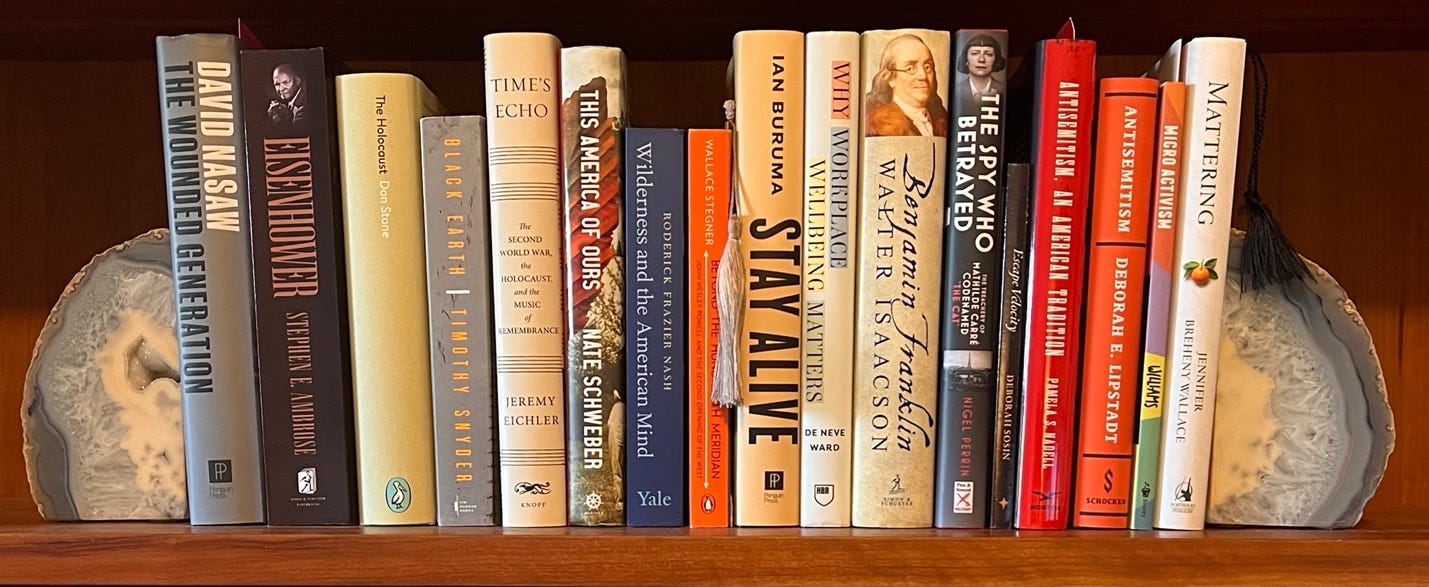
Here are the stories of men returning from war, physically and mentally injured, and often unwelcome. Of music as culture’s memory. Of the victims of the Holocaust who would never return, and the enduring anti-Semitism their deaths could not blunt. Of what it was like to be a German citizen at the end of the war. Of our unique wilderness heritage and the continuing struggle to preserve it. Of leadership beyond titles.
If Angel Down goes on the shelf, its spine will face the room, like the hundreds of other titles on the bookshelves behind me. With that, it’s not hard to imagine being inside the Nameless Library, scanning titles that were only moments ago concrete and inaccessible to millions. I’m still free to select any title, and that freedom can’t be minimized. I can curl up with that title on the couch, and when I do, watch the library’s once-sealed doors open to discovery, knowledge, and wisdom. For a few moments, today’s onslaught of lies, disinformation, accusations, misrepresentations, bloviating, denials, spins, walk-backs, redactions, and dumpster fires recede into the background.
We’re all looking for safety and comfort in some way. My friend, JoAnne Duncan, is working to find what’s next after resigning from her position as a school principal, a classic example of educator burnout. In this episode, which will air on May 19, we get to the root of things and explore a potential strategy to help untangle that hairball of change and answer the question “What’s next?” Look for it here.
[1] If you’re curious, here are the movie clips. Note how each develops the elements I described above.
You had me at books, Jeff!
Each time I purchase new book I write the following: Ex Libris, Diane Wyzga, the date & where I might have purchased it. When I die folks are welcome to toll the shelves & take home a volume that speaks to them.
The other day a book spoke to me again: The Unlikely Pilgrimage of Harold Fry - one of the several that fell into my lap & set me off on the Camino de Santiago. I read it differently than I first did. I feel the journey that I had no real clue about before.
One of the very best gifts for a young child: a library card.
Yes, e-books & audio serve a purpose; but nothing like holding one in your hands (while snugged under the blankets with a flashlight).
Well done, again!
I so identify with this. Beautifully stated.